If you’re researching portable sanitation as a business, you’ve probably looked at both sides: the traditional porta potty route and the restroom trailer market. They seem similar on the surface — both rent portable restrooms, both serve events and job sites, both involve a truck and a trailer.
But the businesses are fundamentally different. And for a lot of aspiring operators, the restroom trailer side wins on almost every measure that matters.
Here’s an honest breakdown of why.
Portable toilet companies are built on volume. The math only works when you have a lot of units moving frequently, because the per-unit rental rate is low.
A standard porta potty rents for $75–$175 per week, depending on your market. To build a meaningful income, you need a large fleet — often 50, 100, or 200+ units — cycling through customers constantly. That means significant upfront capital, a dedicated pump truck (which can run $80,000–$150,000 new), ongoing fuel and maintenance costs, and the operational complexity of managing hundreds of units across a service area.
It’s a logistics-intensive, capital-heavy business that rewards scale. The operators who do well in the porta potty world have been at it for years and have built infrastructure to match.
For someone just getting started, it’s a hard model to enter profitably.
Restroom trailers operate on a fundamentally different economic structure.
Instead of renting dozens of units at $100 a pop, you’re renting one or two trailers at $750–$2,000+ per event. The fleet you need to build a real income is much smaller. And the customers you’re serving — wedding couples, corporate event planners, festival organizers — are actively looking for a premium option and willing to pay for it.
The entry point is more accessible. A quality restroom trailer can be purchased new for $30,000–$80,000 or found used for less. Depending on your local regulations you may not need a pump truck — a heavy-duty pickup handles delivery. One person can operate the business, at least in the early stages.
This is the most obvious difference. A 4-station restroom trailer renting for $2,000 per weekend generates more revenue from a single transaction than 20 porta potty rentals at $100 each — and requires a fraction of the operational effort.
A porta potty operator might need 80 units to generate $60,000 in annual revenue. A restroom trailer operator might need 2–3 trailers. Fewer assets to maintain, insure, store, and track.
Restroom trailer customers are not price shopping the way porta potty customers often are. A couple planning a $50,000 outdoor wedding is not going to choose a vendor based on who’s $200 cheaper. They’re choosing based on quality, reliability, and trust. That dynamic makes it easier to hold your pricing and build relationships that generate referrals.
Weddings, festivals, corporate events — these happen on a calendar. Once you’re embedded in a regional wedding vendor network or on a preferred vendor list for a venue, you have a repeating source of business rather than hunting for new customers constantly.
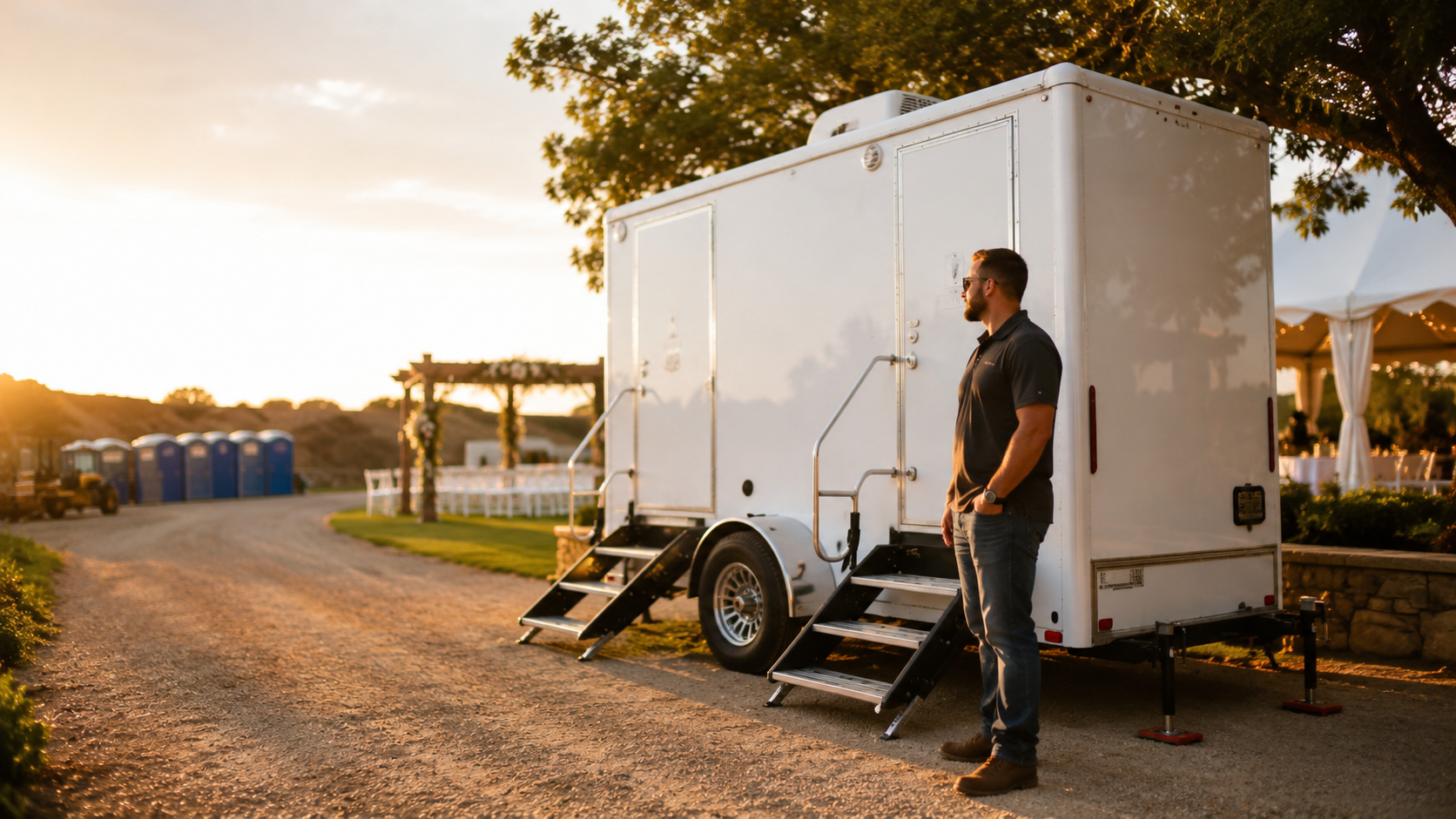
In the porta potty world, one blue box looks pretty much like another. Differentiation is hard and mostly comes down to price and reliability. In the restroom trailer world, the quality of your unit is immediately apparent to customers and guests. A beautiful, well-maintained trailer is its own marketing.
Porta potty operators spend a lot of time pumping waste from units in the field. It’s physical, smelly, demanding work — often across long service routes multiple times a week. Restroom trailer operations involve delivery, setup, and pickup on a defined event schedule. It’s a different quality of daily experience.
This isn’t a one-sided story. There are places where the porta potty model has real advantages.
Pure volume demand. Large construction sites, marathon courses, and major festivals with tens of thousands of attendees across a large footprint need a lot of units spread across a lot of ground. No number of restroom trailers solves that problem.
Faster fleet growth. Because individual units cost less, a well-capitalized operator can build a large porta potty fleet faster than a comparable restroom trailer fleet. Scale has its own advantages in a market with high baseline demand.
Barrier to entry is lower for competitors too. The flip side of porta potties being easier to enter is that your competitors can enter just as easily. The restroom trailer market has a higher barrier — better equipment, different customers, more upscale presentation — which keeps a lot of casual competitors out.
For most aspiring operators who want to build a profitable business without massive capital and without becoming a logistics operation from day one, restroom trailers are the better path.
Here’s a simplified comparison of two hypothetical year-one operators in the same market:
The numbers aren’t identical in every market and every situation, but the structural difference is real. Fewer assets, less operational complexity, stronger margins per transaction.
The restroom trailer model works best for operators who:
It’s not a passive business. You’re delivering heavy equipment to events where things have to go right. But the economics are compelling, the entry point is achievable, and the market for quality restroom solutions isn’t going anywhere.
The opportunity looks different depending on where you are, what events are happening around you, and what the competitive landscape looks like locally. That analysis is exactly what we help you work through.
A simple system to help you see if this business can work in your area — before you spend money on equipment.