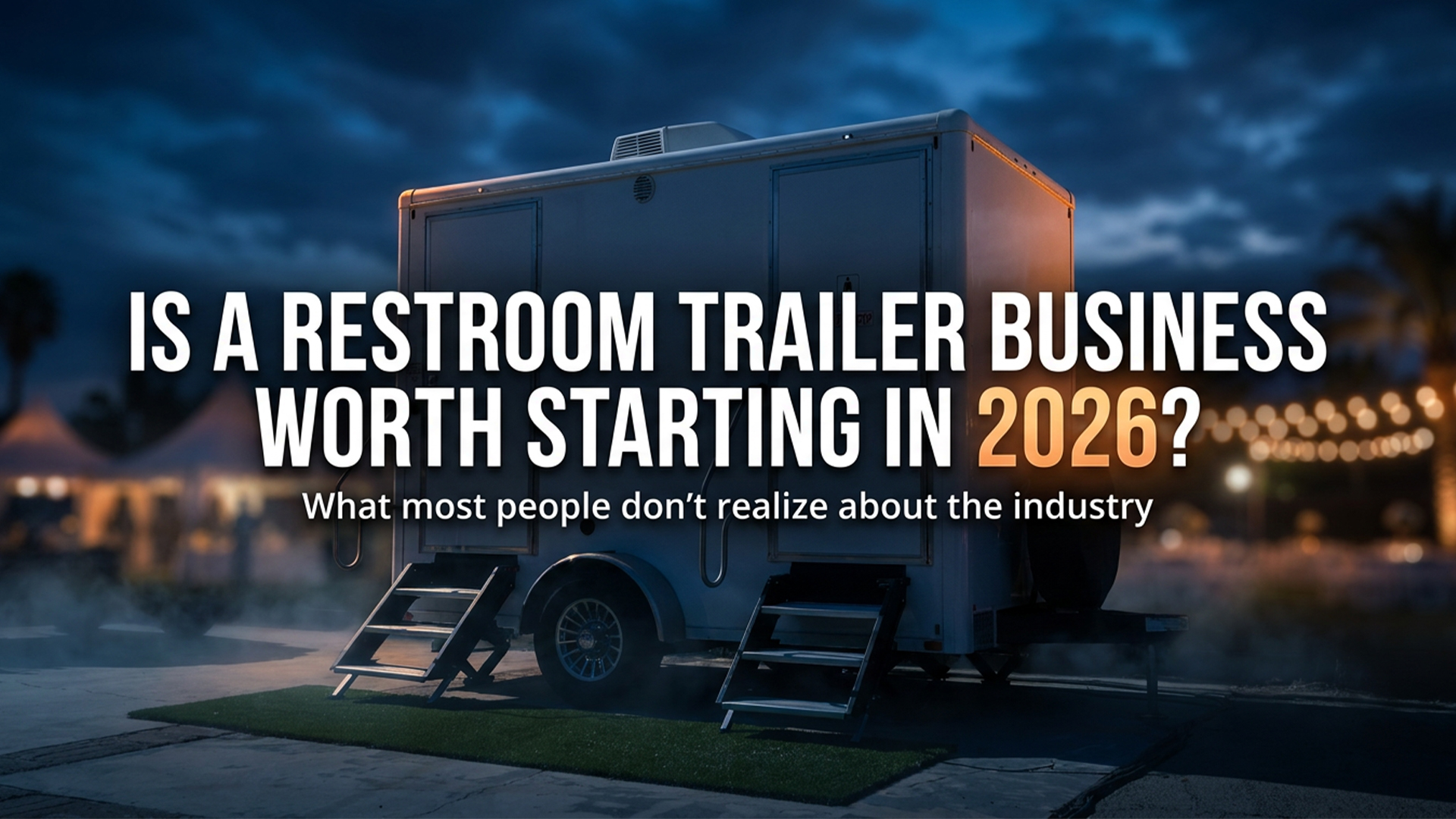
If you’ve been researching service-based business ideas, you’ve probably come across restroom trailer rentals at some point — and if you’re anything like most people who find this industry, your first reaction was some version of: wait, people actually make real money doing this?
They do. And 2026 is one of the better times to take a serious look at why.
This isn’t a get-rich-quick business. It’s not passive income. But for the right operator in the right market, a restroom trailer rental business offers something genuinely rare: high-ticket recurring revenue, real demand from multiple customer types, and a service category where most of the competition isn’t very good.
Let’s break down what the opportunity actually looks like.
A restroom trailer rental business is exactly what it sounds like: you own one or more luxury mobile restroom trailers and rent them out for events, commercial projects, and other situations where quality restroom access is needed but not available.
Your customers pay a rental fee — typically anywhere from $700 to $5,000+ per booking depending on the trailer, the market, and the duration — and you deliver, set up, service if needed, and retrieve the unit when the rental period ends.
The business model is straightforward. You own equipment, you keep it booked, and you build a reputation that makes customers call you first.
What makes it interesting is the math. A single mid-size trailer renting at $1,500–$2,500 per weekend booking, consistently booked through peak season, generates revenue that most people don’t associate with “a bathroom rental.” Add a second trailer, build out your long-term contract business, and the numbers start to look like a real company.
One of the first things that surprises new operators is how many different customer types need what they’re selling.
Most people assume it’s mostly weddings. Weddings are a real demand — outdoor ceremonies, backyard receptions, and venues without sufficient restroom capacity all create consistent bookings, especially from spring through fall. But weddings are just one lane.
Business and commercial renovations are a frequently overlooked source of demand. When a restaurant, office building, medical facility, or retail space takes a bathroom out of service for renovation, they still have staff and customers who need somewhere to go. A restroom trailer parked outside solves the problem cleanly and professionally — and businesses are willing to pay for something that doesn’t embarrass them in front of customers.
Corporate events and brand activations — outdoor company retreats, product launches, VIP hospitality spaces — all demand a higher standard than a row of standard portable units. Companies paying for a premium experience don’t want their guests walking into something that undercuts it.
Festivals and public events create both volume demand and premium upsell opportunities. Many event producers use a mix of standard portable toilets and restroom trailers for VIP sections, staff areas, or premium guest zones.
Emergency response and disaster relief generates urgent, high-value demand during infrastructure outages, utility failures, and insurance restoration projects. Operators who are positioned and available when emergencies happen often command premium rates.
The point isn’t that you’ll serve all of these markets at once — especially not starting out. The point is that demand isn’t tied to one customer type or one season. That diversification is part of what makes the business model durable.
Beyond the demand picture, there are a few structural reasons why restroom trailer rentals attract serious entrepreneurs.
It’s a high-ticket service in a low-expectation industry. Most of the portable sanitation industry has set a very low bar. Standard portable toilets are cheap, widely available, and universally disliked. Restroom trailers exist at the other end of that spectrum — and because the competition is often small, local, and not particularly sophisticated about marketing or customer experience, there’s real room to stand out without doing anything extraordinary. Show up on time, deliver a clean unit, and communicate well, and you’re already ahead of a meaningful portion of the market.
The equipment holds its value. A well-maintained restroom trailer doesn’t depreciate the way a vehicle or tech equipment does. Operators who take care of their fleet have an asset that continues to generate revenue for years — and retains resale value if they ever want to exit or upgrade.
Long-term contracts create predictable revenue. Event rentals are great for cash flow, but long-term contracts — commercial renovations, construction projects, ongoing event venue relationships — create the kind of predictable monthly revenue that makes a business easier to plan and grow. Operators who actively pursue both build more stable operations.
The competition is real — including at the national level. This isn’t a business where you’re only competing with other small local operators. Companies like United Rentals operate restroom trailer rentals out of 1,400+ locations across the country, with established fleets, brand recognition, and existing commercial relationships. That’s a real competitive consideration — particularly when pursuing larger commercial or construction contracts where procurement teams may default to vendors they already work with.
Where independent operators tend to win is on experience quality, responsiveness, and relationships. A national equipment company renting a restroom trailer is a transaction. A dedicated local operator who shows up personally, maintains their fleet obsessively, and follows up after every event is a vendor people call back — and refer to their networks. The operators who thrive understand exactly who they’re competing with and position accordingly.
This is where honest expectations matter. The restroom trailer business is not a low-barrier-to-entry opportunity. The equipment is expensive, the logistics are real, and the operators who succeed treat it like a business from day one.
Equipment costs are significant. A new restroom trailer can range from $20,000 to $80,000+ depending on size and finish level. Used units are available at lower price points but require careful inspection. You’ll also need a tow vehicle capable of hauling the trailer — which is an additional cost if you don’t already have one.
Operations require systems. Delivery, setup, servicing, waste disposal, cleaning, and maintenance all have to be handled reliably. One bad experience at a wedding or corporate event can damage your reputation in a market where word of mouth moves fast. Operators who build clean processes early scale much more smoothly than those who figure it out as they go.
Marketing requires intentionality. The restroom trailer business is not one where customers automatically find you. Building a pipeline of event bookings and commercial contracts requires showing up in the right places — search results, wedding vendor directories, event planning networks, and local business relationships. Operators who invest in their marketing early build a competitive advantage that compounds over time.
None of this is meant to be discouraging. It’s meant to be accurate. The opportunity is real — but it rewards preparation, not impulse.
A few things make this a particularly interesting moment to enter the market.
Outdoor events have continued growing as a category. Couples choosing outdoor weddings, companies hosting off-site experiences, and festivals expanding their footprint all feed demand for mobile restroom solutions. That trend shows no signs of reversing.
Consumer expectations have also shifted. Guests who have experienced a luxury restroom trailer at an event don’t forget it — and event planners who’ve seen the difference in guest feedback start requesting them proactively. As awareness of the product grows, operators benefit from a market that’s increasingly pre-sold on the concept.
At the same time, many local markets are still underserved. In smaller cities, suburban areas, and emerging event markets, there’s often minimal competition and strong unmet demand. Getting in early in the right market means building brand recognition and customer relationships before the market gets crowded.
A restroom trailer business is worth starting in 2026 if you’re willing to approach it seriously — understand your market, invest in quality equipment, build real operations, and show up for your customers consistently.
The demand is there. The revenue potential is real. And in an industry where the bar for quality and professionalism is still surprisingly low, a well-run operation has every opportunity to become the name people call first.
The question isn’t really whether the business is worth starting. The question is whether it’s worth starting in your market — and whether you’re set up to execute.
At Restroom Trailer Pro, we help aspiring operators evaluate local demand, competitive conditions, startup costs, and revenue potential — so you can make a confident, informed decision before putting money on the line.
A simple system to help you see if this business can work in your area — before you spend money on equipment.